
Audiozen & Si-C Mosfets
Audiozen is high-end innovation
Clichés?
No, thanks.
Audiozen innovates
In high fidelity and high-end world often commonplaces are so deeply rooted in audiophiles that many manufacturers, on the other hand, do not bother to go beyond, looking for new devices to renew their products.
We are not talking about controls and circuits that can make easier the management of the appliances, but about the research of new devices that can hide unexpected positive listening performances.
Audiozen in recent years invested many resources in research and development of solid-state power stages adopting modern devices: it begins in 2015 with the use of IGBT (Insulated Gate Bipolar Transistor) and the excellent feedback obtained also overseas gave reason to this first challenge.
However, the real breakthrough comes in 2019 when, after months of testing, Audiozen decided to give up on IGBT for the new silicon carbide (Si-C) Mosfet.
The Silicon Carbide Mosfet

The story of silicon carbide begins in the stars, quite literally. Natural silicon carbide, also known as moissanite, is a rare mineral found in meteorites. On Earth, it’s synthesized in high-temperature furnaces, where a mixture of silica sand and carbon is transformed into Si-C crystals.
Let’s explore the fundamental properties that set it apart from traditional silicon:
- Wide Bandgap: Si-C has a bandgap nearly three times that of silicon, which translates to higher electric field strength and power-handling capabilities.
- High Thermal Conductivity: With thermal conductivity much higher than silicon, Si-C devices can operate at higher temperatures, improving performance and reliability.
- High Breakdown Voltage: Si-C can withstand high voltages before breaking down, allowing for devices with thinner, more efficient designs.
- Chemical Inertness: SiC is resistant to chemical erosion, which is critical for devices exposed to harsh environments.
Si-C Mosfet is synonymous of reliability and power, and it can get its best qualities when implemented in a well designed power stage, ensuring unrivalled speed, transparency and control.
Thanks to the foresight of Nino Pistone (Audiozen’ founder and project designer), at present Audiozen is probably the only high-end manufacturer in the world that chose to equip its class AB power stages with Silicon Carbide Mosfets.
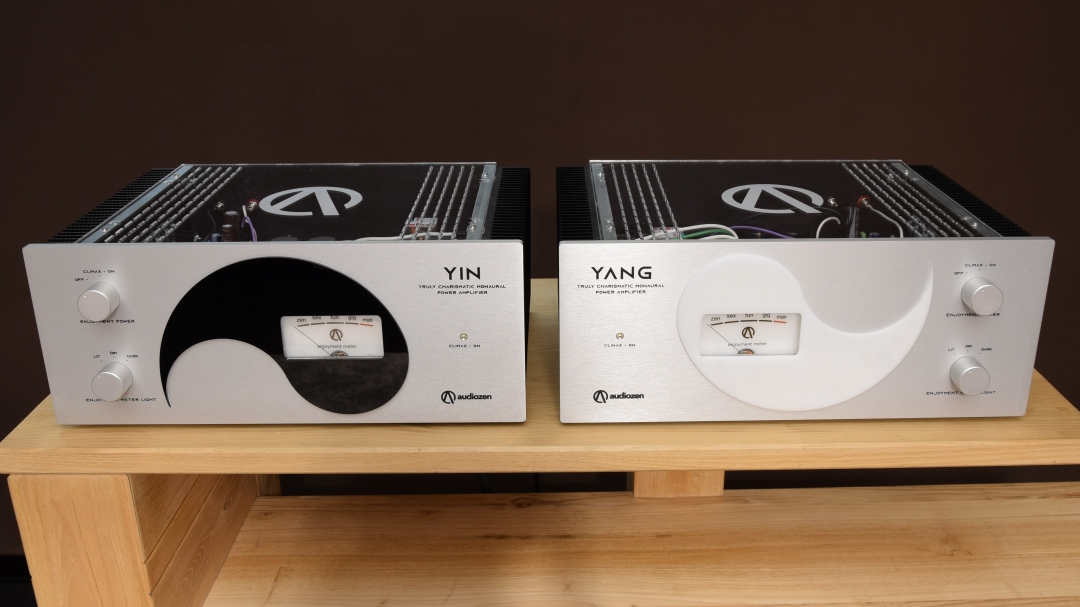
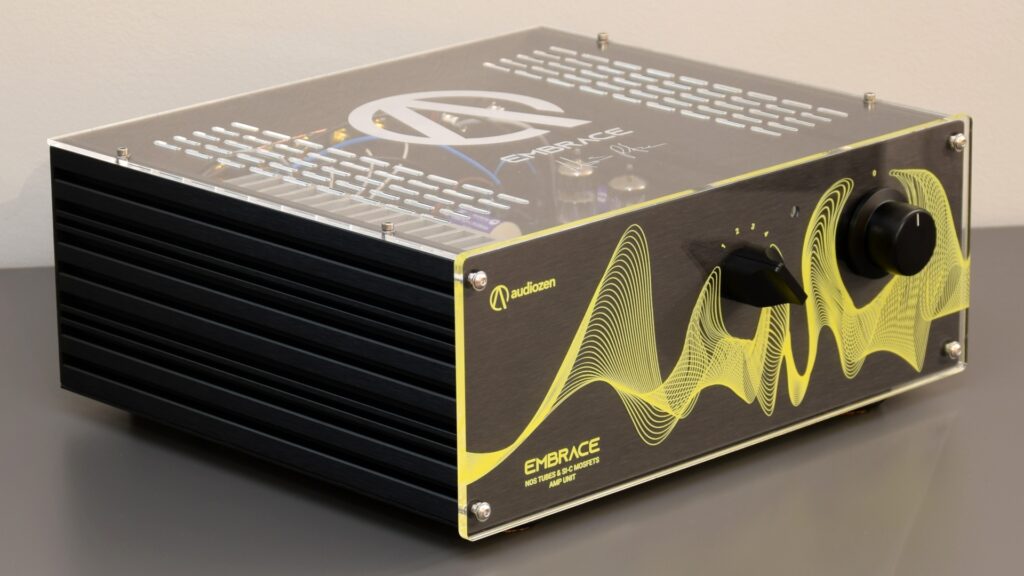
Since 2019, Audiozen has tested dozens of Si-C devices, and has now reached the third generation of Silicon Carbide Mosfets (SIC FET 3), which are used in all the power stages of its power amplifiers and integrated amplifiers: the Yin-Yang monophonic power amplifiers and the P-Stone I dual mono power amplifier, the Solido and the Embrace integrated amplifiers.
The musical event is thus extremely realistic, with an astonishing separation of the three dimensions of the sound planes, enriched by an amazing speed and control of the low frequencies.
Audiozen is clear proof that innovation in high-end audio is still possible today, because awareness changes things.
Yin & Yang
P-Stone I

Embrace
Solido

The specifications of Si-C Mosfet
The comparison chart provides a comprehensive overview of the differences between a traditional silicon mosfet – which has been used by various manufacturers in many power amplifiers over the years – and the three generations of Si-C Mosfets that have been featured in Audiozen’s products since 2019, highlighting in a few lines the outstanding characteristics of these modern devices.
|
Standard Silicon Mosfet vs Audiozen Si-C Mosfets comparative table |
||||
|---|---|---|---|---|
|
|
STD silicon mosfet (IRFP240)
|
audiozen si-C mosfet (2019 – 2021) |
audiozen SIC FET 2 (2022 – 2026) |
audiozen SIC FET 3 (2026 -) |
|
drain – source max voltage
|
200 v
|
650 v
|
700 v
|
700 v
|
|
max current
|
20 a
|
21 A
|
38 a |
46 a |
|
RDS ON1 |
180mΩ
|
120mΩ
|
75mΩ
|
50mΩ
|
|
threshold voltage2
|
2 v
|
2,7 v
|
1,8 v |
1,8 v |
|
input capacitance3
|
1300pF
|
460pF
|
655pF
|
940pF
|
|
current rise time4
|
51nS
|
21nS
|
9nS |
8nS |
|
current fall time4
|
36nS
|
14nS
|
10nS |
10nS |
|
total gate charge5
|
70nC
|
38nC
|
38nC |
46nC |
1: The resistance value between the Drain and Source of a mosfet during operation (ON) is called the ON Resistance (RDS ON).
The smaller this value is, the lower the power loss.
2: Gate – Source threshold voltage VGS(th) is the voltage required between the Gate and Source to turn ON the mosfet. In other words, supplying a voltage greater than VGS(th) will turn ON the mosfet.
3: Capacitances affect the performance of a power mosfet. The smaller this value is, the better its performance will be.
4: Si-C mosfets are more than 7 times faster than silicon mosfets. The faster the better.
5: The Total Gate Charge (Qg) is the amount of charge that needs to be injected into the gate electrode to turn ON (drive) the mosfet.
The unit of Qg is the Coulomb (C), and if the total gate charge is large, it will take time to charge the capacitor necessary for turning ON the mosfet, increasing energy loss.
